
On Pharaoh’s orders, he was supposed to have died at birth. But thanks to a brilliant trick by his mother and sister, he survived. Although his name is not found in Egyptian documents, very few people are as important as Moses in Judeo-Christian tradition. Indeed, Moses is the one God chose and entrusted with the mission of delivering his people from the slavery of Egypt and leading them to the Promised Land. Yet Moses is the prince turned herdsman. He is the foreigner who became the liberator of God’s people in Egypt. The story of Moses is one of the most enigmatic for the historian. His life has been subjected to a variety of interpretations and analyses, whether from the point of view of archaeology, history or theology. In this mini-dossier, we shed light on the life and history of this leader who is said to have lived for over 3,500 years, and whose story forms the foundation of Judaism.
Birth and youth of Moses
Told in the books of Exodus, Leviticus, Numbers and Deuteronomy, the life of Moses is a veritable saga. Woven around deliverance, divine commandments and strange miracles, his life begins in Egypt, at a time when the Hebrew people, descendants of Jacob and Abraham, are enslaved.
Sensing the threat of their rapidly growing numbers, Pharaoh decreed that all newborn Hebrews, if male, were to be killed. The child Moses was born in this context and escaped death. Indeed, his mother Jochebed, moved by the faith engendered by maternal love, placed her baby in a basket covered with bitumen, which she set down on the Nile.
The basket containing the baby was found by the Pharaoh’s daughter, who couldn’t resist the emotion of the moment. The young girl decided to adopt the Egyptian baby and gave him the name we still know today: Moses. The meaning of this name? Saved from the waters. So begins the story of the man who, a few decades later, would become Egypt’s arch-enemy.
Moses’ youth was that of a prince, as he lived in the royal court. But the adopted prince continued to feel the flow of Hebrew blood within him. Witnessing a violent attack by an Egyptian on a Hebrew, he threw himself on the Egyptian, snatching his life and hiding his body. The affair soon became known and Moses had to flee to avoid reprisals. He went to Midian, a region in north-western Arabia.
It was the land of Midian that gave him his wife, who was none other than the daughter of the Midian priest who had sheltered Moses. In Midian, Moses became a shepherd. He had to tend the flocks of his father-in-law Jethro on Mount Horeb. For forty years, this was his job. Little did he know that this was a period of spiritual preparation for the mission God was about to entrust to him.
Moses, liberator of the Hebrews: the encounter at the burning bush
Moses the shepherd went about his daily business as usual. One day, on his way to Horeb, he had a very unusual experience. He came face-to-face with a burning bush that burned without being consumed. Moses was captivated. He heard Jehovah speaking to him through the bush, revealing the mission he was to undertake.
Moses was to free the Israelites from Egyptian slavery and lead them to a promised land that God would show him. The promised land is a land flowing with milk and honey. Moses hesitated at first, hiding behind his alleged inability to carry out this mission, but God reassured him. He would be assisted by Aaron, his brother. Aaron would be his spokesman. Moses accepted the mission and returned to Egypt with Pharaoh. Thus began a new adventure in the life of Moses, who became the greatest of the Old Testament prophets.
Moses, the liberator of the Hebrews: the Hebrews’ victory over Pharaoh
In Egypt, Moses asks Pharaoh to let the Hebrews go so that they can serve God. As you might expect, Pharaoh opposed this bold request. To force his hand, God inflicted a series of ten plagues on Pharaoh’s land that served to demonstrate divine power. First, he turned the water of the Nile into blood. Then he sent an army of frogs, lice and flies. He also sent cattle plague, ulcers, hail, locusts, darkness.
The last plague to break Pharaoh’s resistance and intransigence was the death of Egypt’s first-born. After this, Pharaoh let go and allowed the Israelites to leave. This historic event is celebrated every year at Passover to commemorate the deliverance of the Hebrew people from slavery in Egypt.
Having received Pharaoh’s unexpected permission, the Israelites rushed out of Egypt. This exit from Egypt consecrated a covenant that is celebrated to this day in Judeo-Christian tradition. After a while, Pharaoh changed his mind and pursued them with his troops, catching up with them at the Red Sea. When the Israelites reached the Red Sea, they were surrounded from behind by Pharaoh’s army.
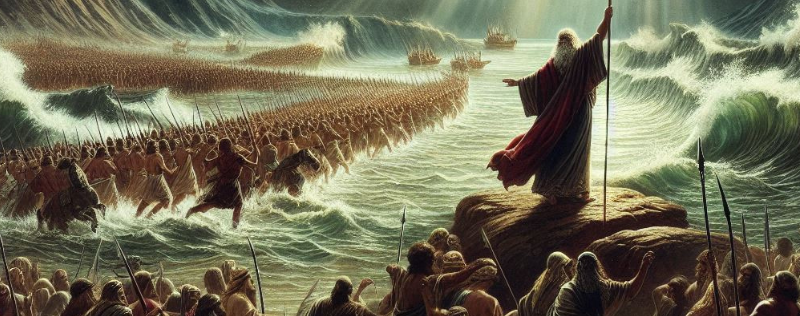
On God’s instruction, Moses spread his shepherd’s staff over the waters of the sea, which parted, allowing the Israelites to cross on dry land. After the Egyptians had crossed, the same waters closed over Pharaoh’s army, marking the end of their journey. They all died, swallowed up, a miracle that remains to this day one of the most powerful wonders God performed through Moses. In sermons, this event is often mentioned as one of the greatest acts of divine deliverance.
Moses, receive God’s Ten Commandments
On leaving the Red Sea, the Israelites, God’s chosen people, stopped at the foot of Mount Sinai. For forty days and forty nights, Moses would be on that mount to receive God’s Ten Commandments, a battery of laws and directives intended to organize the socio-religious life and govern the moral and civic issues of the Israelites, who henceforth formed a nation in their own right. These Ten Commandments were to become the foundation of the Mosaic Law and the Judeo-Christian faith.
Sadly, Moses was still on Mount Sinai when the restless and impatient Israelites, who didn’t know when Moses would return, had a god made. Aaron was the one who made the god, which was a golden calf. Idolatry thus entered the camp of Israel. Moses was inflamed by the sight as he came down from the mountain.
In a moment of anger, he broke the Tables of the Law that God had given him. He returned to Mount Sinai to observe a second period of 40 days to implore God’s mercy on behalf of the people who had betrayed him by sinning against him. God showed them mercy and renewed his covenant with the people of Israel. New tablets of the law are engraved to replace those broken by Moses in a fit of anger.
Crossing the desert
If Moses spent 40 days on Mount Sinai to receive the divine laws, the people of Israel spent 40 years in the desert before reaching the Promised Land. It was a very long journey, marked by a series of trials, rebellions and murmurings. The leader of the people, Moses, also faced great difficulties in trying to lead his people, who demanded that he find a way to quench their thirst and appease their hunger. There were even plots against Moses within the ranks of the people. It took a lot of effort to keep the faith and keep them obedient to God. The deliverer of the Israelites was to continue guiding the people, teaching them the divine laws and preparing the next generation to enter the Promised Land.
Moses’ journey came to a halt in the desert. Despite his pleas, he could not enter the Promised Land. This sentence was inflicted on him because he was guilty of disobedience. God had asked him to speak to the rock so that it would give them its waters. Moses, under pressure from the people, struck the rock twice, bringing down upon himself the sentence of the Lord.
His punishment was that he would not be able to enter Canaan, the promised land. He could only see it from a distance. Moses died at the age of 120 on Mount Nebo, where he could see Canaan from afar. According to the Bible, God himself buried him in a valley in Moab. No one knows of his tomb to this day.
The life of Moses: what do history and archaeology have to say?
While the biblical texts are very convincing about the story of Moses, as they are about the stories of other biblical figures, historical and archaeological perspectives subject these stories to debate. Indeed, biblical stories are considered not only as literary and theological texts, but also as historical texts.
In order to enjoy the seal of absolute credibility, these stories must be supported by archaeological evidence. Yet much controversy has arisen around the archaeological evidence relating to the Hebrew exodus and the decades they spent in the desert. According to some scholars, the story of Moses has its origins in old oral traditions that, over time, have been embellished.
In fact, many Egyptologists and historians have taken it upon themselves to look for evidence of possible correlations between Egyptian archives and biblical accounts. Some of them have suggested that Moses may have lived in a period of crisis or transition in Egypt around 1550 and 1070 BC. They have also noted that the ten plagues of Egypt could be natural disasters that occurred during this period.
The figure of Moses, seen through spiritual and theological prisms
However, spiritual and theological perspectives on the figure of Moses are totally different from what historical and archaeological debates suggest. For Jews, Moses is not a historical figure.
His figure carries a very strong theological and spiritual significance. According to the Jews, he is the mediator of the covenant between God and the people of Israel. Jews consider him to be the greatest prophet, and credit him with writing the first five books of the Bible (Old Testament), known as the Pentateuch.
In Christian tradition, Moses is more than just a prophet. A symmetry is established between him and Christ, by considering him the forerunner of Jesus Christ. This symbolism can even be found in Christian jewelry, which embodies this spiritual connection through representations of Moses or other biblical symbols. It’s worth remembering that even among Muslims, the name Moses comes up very frequently. Called “Moussa”, he is considered a major prophet, and a model of faith and perseverance for the believer who wishes to walk with God.
The Bible also recognizes Moses as the most humble man on earth in his time. He left a very rich heritage to the Jewish and Christian people. In Deuteronomy 32, for example, he wrote a farewell canticle, which he taught to the people of Israel in their final days.
Moses leaves behind a people who have not seen the plagues and miracles with which God freed his people from Egypt. He leaves them this hymn to perpetuate the memory of events they did not experience, but which are to form the basis of their faith and nourish their attachment to the covenant God made with their fathers.
Later in the New Testament, we learn that after the death of Moses, the devil disputed his body with the angel Michael. So the story of Moses is a prefigurement of the New Covenant that Jesus Christ came to implement later in life.