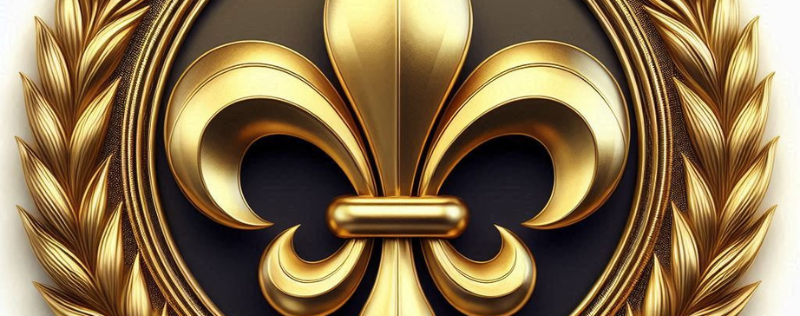
For centuries, the fleur-de-lis has fascinated and intrigued. Adorned on royal coats of arms, cathedral stained-glass windows and master canvases, it is adorned with a multitude of meanings, each weaving a unique tale through time. Let’s explore the different facets of the fleur-de-lis, deciphering its symbolic origins and its evolution over the centuries. From its royal heritage to its religious dimension, via its cultural and artistic interpretations, let’s dive into the richness of a universal and timeless symbol. Let yourself be guided by the bewitching beauty of the fleur-de-lis, and discover the secrets it has whispered through the ages.
Historical symbolism of the fleur-de-lis
Throughout history, the fleur-de-lis has been used to express a multitude of ideas.
Origin and representations
The exact origin of the fleur-de-lys as a symbol remains uncertain. Some link it to the marsh iris, while others see it as a stylization of the white lily, a wildflower found in Europe and Asia. Historian Michel Pastoureau suggests a more prosaic origin, the fleur-de-lis being a simple stylization of a Frankish spear.
As far back as antiquity, the fleur-de-lys appeared in various cultures, symbolizing purity, royalty and prosperity. It can be found in Egyptian, Greek and Roman art, often associated with important divinities.
- In Egypt, the fleur-de-lis was associated with the goddess Isis, symbol of life and motherhood.
- In ancient Greece, it was the attribute of Hera, queen of the gods, and symbolized marriage and fertility.
- In Roman times, the fleur-de-lis was associated with the goddess Fortuna, goddess of luck and destiny.
In the Middle Ages, the fleur-de-lis became a ubiquitous symbol in Europe. It was adopted by French royalty, becoming the official emblem of the monarchy under the reign of Clovis. Legend has it that the Frankish king received a chasuble studded with fleur-de-lis at his baptism, giving the symbol a divine and sacred dimension.
The fleur-de-lys and royalty
The fleur-de-lys became a symbol of power and authority, appearing on flags, coats of arms and royal seals. It is also used to decorate royal garments, jewelry and objets d’art.
The number of fleurs-de-lis on a coat of arms can vary, and has a particular meaning. For example, the kings of France wore three fleurs-de-lis, symbolizing the Holy Trinity.
- One fleur-de-lys: Unity, perfection, faith.
- Two fleur-de-lys: Alliance, harmony, balance.
- Three fleur-de-lys: Holy Trinity, charity, hope, faith.
- Four fleur-de-lys: Justice, prudence, strength, temperance.
The fleur-de-lys is also found in the coats of arms of many other European royal and noble families, such as the Plantagenets of England, the Habsburgs of Austria and the Hohenzollerns of Germany.
Expansion and international influence
The influence of the French monarchy contributed to the spread of the fleur-de-lis throughout Europe. Many royal and noble families adopted the symbol, recognizing its prestige and power.
The fleur-de-lis was also present in the French colonies, appearing on the flags and coats-of-arms of territories such as Canada, New Orleans and Louisiana.
The fleur-de-lys in art and architecture
The fleur-de-lys is a ubiquitous motif in medieval and Renaissance art and architecture. It can be found on sculptures, stained glass windows, tapestries and illuminations. Notre-Dame Cathedral in Paris is a striking example of the use of the fleur-de-lys in architecture. It can be found on portal sculptures, stained glass windows and gargoyles. The Château de Versailles is another notable example. The fleur-de-lys is featured on ceilings, chandeliers, furniture and tapestries.
The fleur-de-lys in popular culture
The fleur-de-lys is also present in popular culture, appearing in fairy tales, songs and legends. For example, in the fairy tale “Beauty and the Beast”, the Beast gives Belle a red rose under a glass bell. The rose is often seen as a symbol of love and passion, and the fleur de lys is sometimes used as an alternative to the rose in this tale. In addition, Leonard Cohen’s song “Fleur de lys” is an ode to the beauty and fragility of the flower.
Religious significance of the fleur-de-lys
The fleur-de-lis appears many times in religious symbolism.
The fleur-de-lys and the Virgin Mary
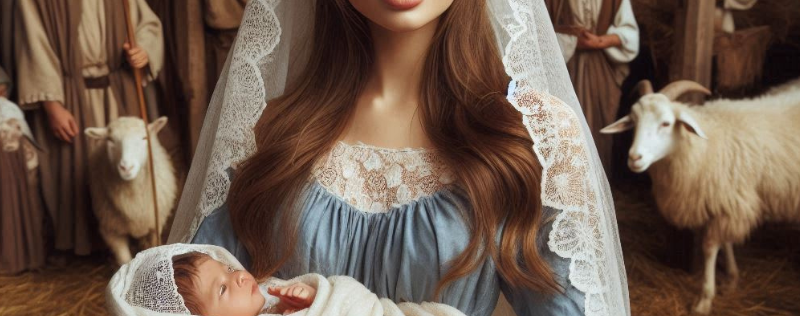
In the Christian religion, the fleur-de-lis is a ubiquitous symbol, often associated with the Virgin Mary. Its immaculate whiteness symbolizes the purity and virginity of the Mother of God, while its shape evokes the Trinity.
- The fleur-de-lis is often depicted in Christian art, notably in paintings and sculptures of the Virgin Mary. It can be found in works by renowned artists such as Leonardo da Vinci, Raphael and Botticelli.
- The Virgin Mary is often depicted holding a lily in her hand, symbolizing her purity and divine maternity.
- She is also depicted in the stained glass windows of cathedrals and churches, as well as on vestments and liturgical objects. The chasuble, the vestment worn by priests at mass, is often decorated with fleurs-de-lis.
Symbolism of the fleur-de-lys in Christianity
The fleur-de-lys has a rich symbolism in Christianity, representing :
- Purity and virginity: The immaculate whiteness of the flower is associated with the purity and virginity of the Virgin Mary. It also symbolizes purity of soul and innocence.
- The Trinity: The tripartite shape of the fleur-de-lis is often interpreted as a symbol of the Holy Trinity (Father, Son and Holy Spirit). The flower’s three petals represent the three persons of the Trinity, united in a single essence.
- Hope and charity: The fleur-de-lys is also associated with hope and charity, two important Christian virtues. Hope is trust in God and His promises, while charity is love of neighbor.
- Immaculate Conception: The doctrine of the Immaculate Conception, which states that Mary was conceived without original sin, is often represented by a fleur-de-lys. The whiteness of the flower symbolizes Mary’s immaculate purity from the moment of her conception.
The fleur-de-lys in the litanies of the Virgin Mary
The fleur-de-lis is also present in the litanies of the Virgin Mary, a series of prayers invoking the Mother of God under different titles.
- “Tower of David”: The fleur-de-lys is sometimes called “Tower of David” in the litanies, symbolizing the Virgin Mary’s strength and protection. The tower is a symbol of protection and security, and Mary is invoked as protector of the faithful.
- “Mirror of Justice”: The whiteness of the fleur-de-lis is also associated with justice and truth, and Mary is often invoked as the “Mirror of Justice”. She is a model of justice and truth for the faithful.
- “Mystic Rose”: The lily flower is also called the “Mystic Rose” in litanies, symbolizing the love and beauty of the Virgin Mary. The rose is a symbol of love and passion, and Mary is invoked as the embodiment of maternal love and compassion.
The fleur-de-lys in Marian apparitions
The fleur-de-lys is also present in accounts of Marian apparitions. During her apparitions to Bernadette Soubirous in Lourdes in 1858, the Virgin Mary appeared holding a rosary in one hand and a white rose in the other. The white rose is often interpreted as a fleur-de-lys.
During her apparitions to Lucia dos Santos and her cousins Francisco and Jacinta Marto at Fátima in 1917, the Virgin Mary asked the children to pray for the conversion of sinners. She also promised to return to earth “at the end of the war”. This promise is often interpreted as a reference to the end of the First World War, which ended a few months later.
The fleur-de-lis is a deeply Christian symbol, inseparable from the Virgin Mary. Its presence in art, architecture, liturgy and Marian apparitions testifies to its importance in the Catholic religion. The fleur-de-lis is a symbol of purity, virginity, the Trinity, hope, charity, the Immaculate Conception, protection, justice and love. It should be pointed out, however, that this flower also appears in other religions such as Hinduism, Islam, Judaism and many others.
The fleur-de-lys in art and architecture
Aside from religion, the fleur-de-lis has also inspired other fields such as architecture, jewelry and art.
Architecture
The fleur-de-lys was much in evidence in medieval architecture and the age of recognition.
Medieval period
The fleur-de-lys is a ubiquitous motif in medieval architecture, appearing as early as the 10th century. Its presence is particularly marked in religious buildings, symbolizing purity and sanctity.
- Cathedrals: The fleur-de-lys adorns the portals, stained glass windows, gargoyles and capitals of many Gothic cathedrals, including Notre-Dame de Paris, Chartres, Reims, Amiens and Cologne.
- Abbeys: The fleur-de-lis is also found in abbeys, such as Saint-Denis and Mont-Saint-Michel.
- Churches: The fleur-de-lis is an important decorative element in churches throughout Europe, symbolizing the divine presence.
Renaissance period
The fleur-de-lys continues to be used in Renaissance architecture, but its use extends to other types of building.
- Castles: The fleur-de-lis is an important decorative element in Renaissance castles such as the Château de Versailles, the Château de Fontainebleau and the Château de Chambord.
- Town halls: The fleur-de-lis is also found on the facades of town halls, such as the Hôtel de Ville in Paris and the Hôtel de Ville in Brussels.
- Bourgeois homes: The fleur-de-lys was also used to decorate bourgeois homes, notably on doors, windows and fireplaces.
Sculpture
Sculpture also sometimes refers to the fleur-de-lys.
Religious sculpture
The fleur-de-lys is a popular motif in medieval and Renaissance religious sculpture. It is often featured on statues of the Virgin Mary, saints and angels. The fleur-de-lis is often associated with the Virgin Mary, symbolizing her purity and virginity. It is found in many statues of the Virgin and Child, such as the Vierge à l’Enfant de Chartres (Chartres Cathedral) and the Vierge à l’Enfant de Nicolas de Verdun (Musée du Louvre, Paris).
The fleur-de-lis is also featured on statues of saints, symbolizing their sanctity and martyrdom. The fleur-de-lys is often used to represent angels, symbolizing their purity and perfection.
Secular sculpture
The fleur-de-lys is also used in secular sculpture, notably on statues of kings and queens. The fleur-de-lys is a symbol of royalty and power. It is found on statues of French kings and queens, such as the statue of Charlemagne at Aachen and the statue of Louis XIV at Versailles. The fleur-de-lys is an important decorative motif on column capitals in churches and cathedrals.
Painting
The fleur-de-lys can also be found in paintings.
Religious painting
The fleur-de-lys is a common motif in medieval and Renaissance religious painting. It is often featured in paintings depicting the Virgin Mary, saints and angels.
- Annunciation: The fleur-de-lis is often featured in paintings depicting the Annunciation, symbolizing the purity of the Virgin Mary. A famous example is Fra Angelico’s Annunciation (Prado Museum, Madrid).
- Nativity: The fleur-de-lys is also present in paintings depicting the Nativity, symbolizing the purity and holiness of the Infant Jesus.
- Crucifixion: The fleur-de-lis is sometimes present in Crucifixion paintings, symbolizing Christ’s suffering and victory over death.
Secular painting
The fleur-de-lys is also used in secular painting, notably in portraits and landscapes. The fleur-de-lis is sometimes featured in portraits of kings and queens, symbolizing their royalty and power. It is sometimes used to decorate landscapes in paintings, symbolizing the beauty and perfection of nature.
The fleur-de-lis is a ubiquitous symbol in medieval and Renaissance art and architecture. It is used to decorate churches, cathedrals, castles, town houses, sculptures, paintings and tapestries. The fleur-de-lis is a symbol of purity, royalty, sanctity and perfection.